
5 Supportive Ways To Discuss Drinking And Driving With Your Kids

Many influences are available to young people through media, peers, but perhaps the most powerful are the examples of close family  members who serve as models of behavior—good and bad. Keep these points in mind when discussing drinking and driving with your son  or daughter.

1) Do as I say AND as I do is your best way to model the behavior choices you expect in your young adult. Never expect behavior from your son or daughter that you haven’t demonstrated for them in your life. Your consistent example provides a standard of behavior as well as maintaining your integrity.

2) Deal with alcohol and drug use honestly and set up an atmosphere of trust. You can address your concerns but make it clear that it is more important for you to handle these issues as a family than to keep dangerous secrets. Discuss the fact that personal safety is  much more important than any behavioral expectations. Be clear that you want and need to talk about anything they need to discuss even if  your son or daughter is afraid of disappointing you.

3) Have a plan ahead of time to handle alcohol use of your young driver or their companions. While stressing that your son  or daughter should never drink and drive, it is equally important that they understand they should never get into any vehicle that is being driven by someone who has been drinking. More than half of 15-20 year olds killed in crashes each year are passengers in the vehicle!

Make a promise that you will pick them up or arrange to have them picked up no matter what the hour or situation. This promise doesn’t mean you can’t have a discussion with them after the fact. Leave the discussion to the next day when your emotions and any hangover they may have is stabilized and you both are ready to talk.

Why “10 And 2” Is No Longer The Best Way To Drive

Old-school driving advice said to always hold your hands at “10 and 2.” In other words, if your steering wheel were a clock, your left hand would be at 10 o’clock and your right hand would be at 2 o’clock.

“9 and 3” is the new 10 and 2

Nowadays, however, things are different.

Forget 10 and 2!

Thanks to changes in car technology, as well as realizations about airbags and the need for faster  reactions on the road, experts now call for a lower hand position.

Unfortunately, many teens are still being taught the incorrect 10 and 2 hand position.

6 Ways To Cut Insurance Costs For Teen Drivers – Part 1

The day your teenager starts driving is a significant one. Here are two things that happen to parents almost immediately:

1) You get a proud and warm feeling from seeing your child gaining independence
2) Your get a huge increase in your auto insurance bill.

According to research cited by CBS News, adding a teen to an auto insurance policy can increase rates by a whopping 44 to 62 percent (but getting him or her an individual policy usually costs even more).

This is because most insurance companies consider teenage drivers high-risk drivers, and high risks mean spiked coverage costs. Thankfully, though, you can do something about this.

When your son or daughter turns sixteen and gets behind the wheel, keep these six top tips in mind:

Ways To Cut Insurance Costs For Teen Drivers – Part 2

As promised – here are 3 more ways to cut your Auto insurance premium (after adding a – gasp!!– Teen Driver to your policy.)

4. Pick a Safe Car. While it’s true flashy cars look cool, especially when you’re a teenager, it’s also true that flashy cars tend to require higher insurance premiums. More importantly, ‘too much car’ can get your child killed or permanently disabled.

When it comes to giving your child a car, (or allowing them to buy one themselves) remember that what your teen needs, more than a status symbol, is a safe method of transportation that’s reliable and equipped with up-to-date safety equipment. Give your kids something to drive, whether it’s technically theirs or yours, that will keep them protected on the road — “Look for small or mid-sized cars that are a few years old without being brand new,” says Driver’s Ed Guru. “Sporty cars and SUVs will generally cost significantly more to insure.”

5. Adjust Your Plan. There are always ways to cut down on your car insurance costs, especially if you’re willing to tweak your plan slightly. Ask yourself if you might be able to raise your deductibles, for example. While this would require a greater upfront cost in the case of an accident or other car damage, it also would potentially decrease your monthly rates in the meantime. Likewise, make sure the coverage matches the car your teen is driving. If it’s an old beater, high deductibles are probably the smartest choice, as the value of the car isn’t worth the costs to repair it down the line.

6. Offset the Increase with Other Savings. Another thing to keep in mind is that it’s not just your teen that can qualify for discounts — and any cost savings to your insurance is cost savings worth having.

10 WAYS TO AVOID HYDROPLANING

One of the keys to safe driving for our teens (and ourselves) is to be “ready for anything.”

Stuff Happens when you’re driving—and hydroplaning is one of those things that most of us don’t see coming.

What is Hydroplaning?

It’s that fleeting—but awful—feeling you can get when you’re driving on a wet road and your tires lose contact with the road surface. It generally lasts for only a few seconds, but it can seem much longer as you have no control over your vehicle.

When your vehicle is hydroplaning you’re actually riding on a thin layer of water. You can’t steer. You can’t brake. It’s a scary situation and it can happen on any wet road surface.

What makes it particularly dangerous, however, is that hydroplaning very often occurs during the first 10 minutes of a light rain.

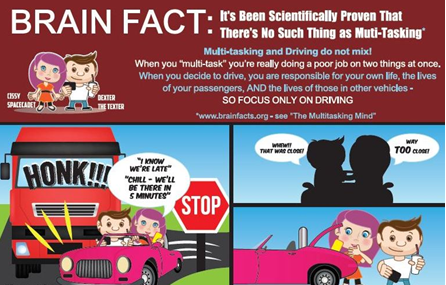
Multi-Tasking Means You Are Doing Two Things At Once- BADLY!

Author

Bob Ragazzo is a certified Defensive Driving Instructor, and the founder of 2 online driver training
companies; 
the non-profit Parents’ Coalition to Stop Teen Driving Deaths NOW! ​and the
​Corporate Driver Training company – Collision Avoidance Technology & Training, LLC.
Most importantly, he is the Father of two young men (who are, of course, well-trained drivers.)


Teenagers think it’s cool to multi-task. They’re masters at it. They watch TV, surf the Internet, text their friends and do their homework — all at the same time.
  
It’s almost like a badge of honor to them to see how much they can do at once. 
Unfortunately, many teens include driving among their multi-tasking list — and that’s a critical mistake.

mind isn’t built for multi-tasking. In fact, the research indicates that multitasking may even have long-term harmful effects on brain function.

One example of this comes from a study by Stanford University   authored by Adam Gorlick  and  researche by the late Clifford Nass. Professor Nass performed experiments with 262 college students that required them to switch tasks, filter irrelevant information and use working memory.  The expectation was that the multitasking students would outperform those that didn’t multitask—at least on some of the activities.

Instead, the results were exactly the opposite.  Multitasking students were abysmal at all three tasks. What was even more alarming was that only one experiment actually involved multitasking. That told Nass that even when they focus on a single activity, those who frequently multitask actually use their brains less effectively.

Download This Important
Free Report!

THE PARENT'S DRIVER-TRAINING BLUEPRINT
A Step-by-Step Guide to Keeping Your Teenage Driver Alive!

*By completing this form you are signing up to receive our emails and can unsubscribe at any time.